My first camera's industrial spark
How two grandfathers (an engineer who built nuclear plants and a pensioner who photographed church archives) taught me that a camera is the minimum viable record of things worth preserving.
A good photograph has always caught my eye. But it’s also something that sparked my industrial curiosity as a boy. Each time I visit my grandparents’ farm in England I get the urge to wander around the house to look at old photos. From the drawing room (overlooking the garden pond), onto the breakfast room, dining room, and the living room. The journey feels endless. However, there’s a few images I keep coming back to.
Two grandfathers
The engineer
Behind the door in the drawing room, there’s a large aerial photograph of the surrounding farmlands. It was taken when I was eight and I’ll never forget the day when the pilot circled above us to take the shot. A month later, my grandpa, an incredible engineer, brought me a tiny but important present. Inside the box was my first camera. Just a simple analogue film camera made from black plastic. That afternoon, he showed me how to frame and expose shots.
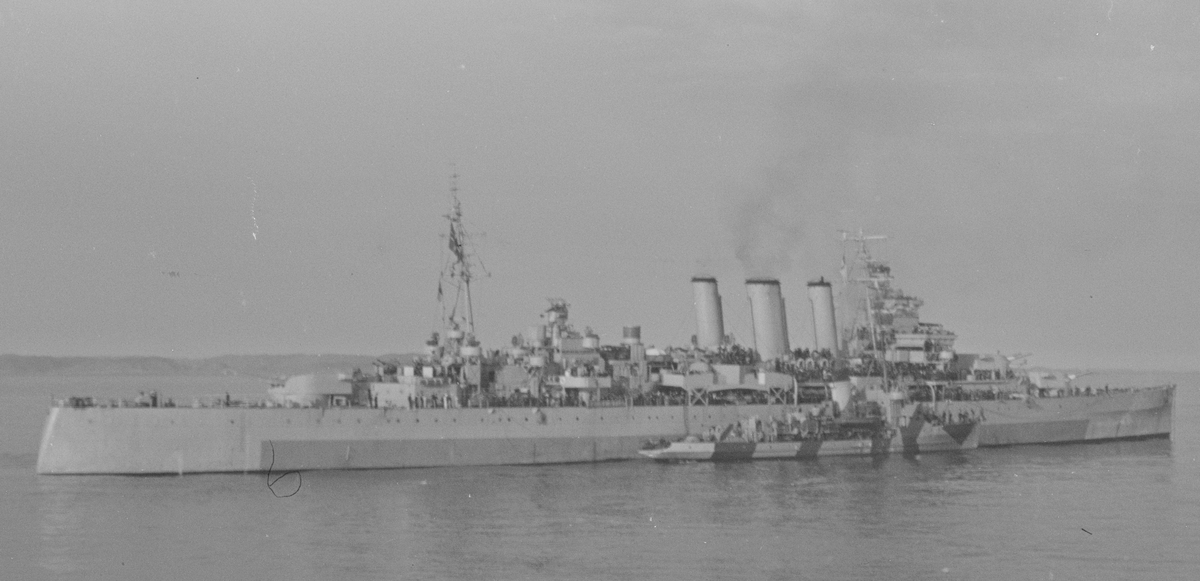
Later, my grandpa brought another gem from his archives: a black-and-white photo taken by his uncle H.M. Wright, a mid-ranking officer in the Royal Navy, of King Haakon VII of Norway during the Norwegian Government’s evacuation from Tromsø on June 7, 1940, by the H.M.S Devonshire.
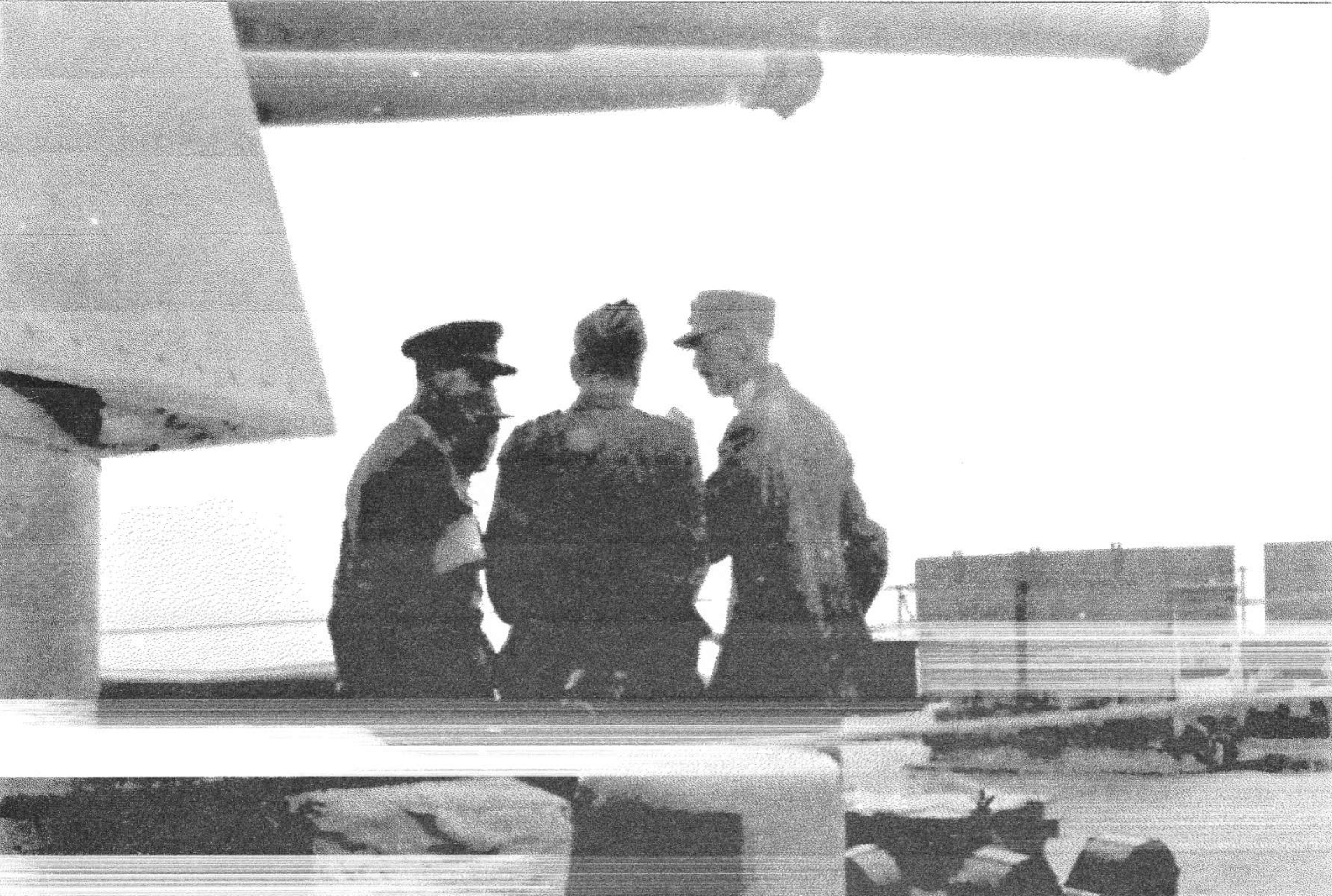
The Devonshire later returned Crown Prince Olav V to Oslo on May 13, 1945, and escorted King Haakon VII back on June 7, 1945, marking Norway’s liberation by the end of World War II.
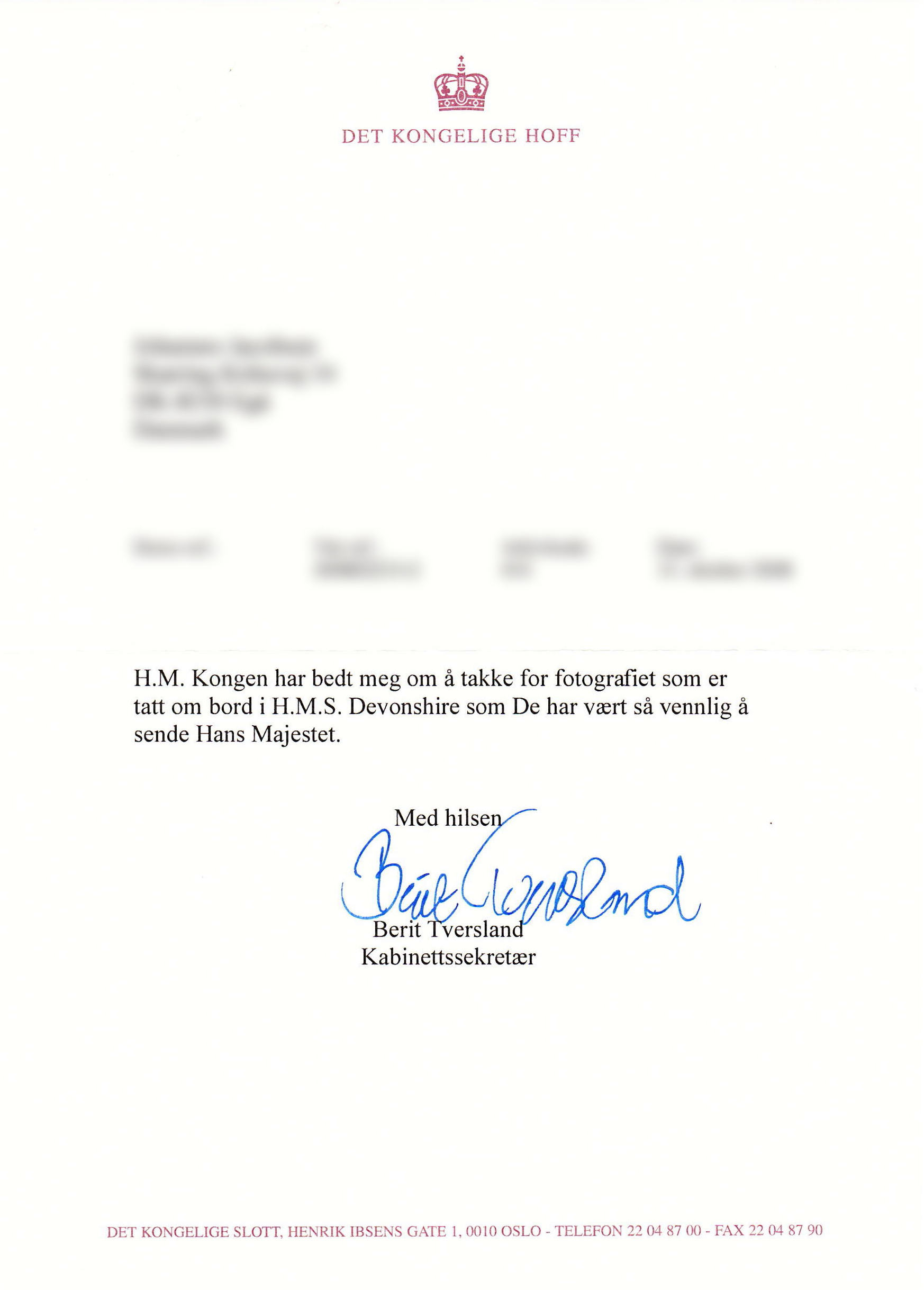
He asked me for help to send the original photo to The Royal Court of Norway in 2008. We were both very excited when we got a reply from Cabinet Secretary Berit Tversland: “H.M. The King has asked me to thank you for the photograph taken on board H.M.S. Devonshire which you have been kind enough to send His Majesty.”
What strikes me now, looking back, is that the HMS Devonshire photograph almost didn’t survive. It spent decades in a drawer, waiting for someone to think it might matter to someone. My grandpa’s instinct (to hold onto it, to eventually bring it out) was the same instinct that made him give me my first camera. Certain things are worth capturing before they’re gone.
He had that instinct in his professional life too. A wonderful engineer who worked on steam engines, jet engines, early nuclear power stations, shatterproof glass, and hovercraft, he was part of a generation that built things by understanding them from the inside. The nuclear plant work stays with me most. As a boy, I’d ask him about the designs: how the systems worked, what the engineers were solving for, what they got wrong before they got it right. He’d explain patiently, and one day he said something I didn’t quite understand until much later: that most of what made those plants work wasn’t written down anywhere. It lived in the minds of the people who built them. When those people retired, much of it retired with them.
He wasn’t being pessimistic. He was being precise. There’s a type of engineering knowledge (call it tacit knowledge) that is not documented easily. The feel of a material under stress. The judgment call you have to make when the textbook doesn’t cover the situation. The reason a particular design choice was made that seemed obvious at the time but unrecoverable fourty years later. My grandpa understood that photographs, engineering drawings, even informal records could carry some of that knowledge forward. Not all of it, but some. At least it’s supposed to be enough to ask better questions.
The representative
My Danish grandfather had a completely different relationship with cameras and archives, though the underlying impulse was more or less the same. He was a representative within the energy industry, and he often worked in Norway.
After he retired, he spent years travelling across Europe (mainly Denmark, Sweden, Norway, and Germany) with a camera and a notebook, tracing his family through census records, church registers, and municipal archives. It was all physical documents, many of them fragile, and in many cases difficult to access. He photographed what he could: handwritten entries, ship manifests, land records. Plenty of those documents have since been digitised in public repositories, so the photographs he took of them are now, in a way, photographs of photographs.
The research led somewhere unexpected. Following one line back through the 17th century, he found Jacob Madsen. He was a Copenhagen based merchant, property developer, and ship owner of some standing, active in the 1600s, and a direct ancestor. Following another line a bit further, he traced a connection to Erasmus Alberus, one of Martin Luther’s closest collaborators during the Reformation. It’s the kind of discovery that is made through methodical archival patience; the same quality, I think, that makes good long-cycle industrial work: the willingness to follow a thread for years without knowing exactly where it leads.
Nevertheless, his photographs captured a form of tacit knowledge too. Not the knowledge of how to build a machine, but the knowledge of who a family was and where it had come from. It’s accumulated, often unrecorded texture of lives lived through particular trades, industries, or specific moments in history.
I’ve been thinking about this more since my grandpa passed away in 2024. He left behind a remarkable set of records (photographs, engineering drawings) but also a silence where the unwritten knowledge used to be. The question he was quietly raising, every time he brought out something from his archives, was the same one that runs through my professional work now: what do we lose when the people who know something stop being around to explain it? And what’s the minimum viable record that lets someone else ask the right questions later?
A photograph turns out to be a surprisingly good answer. It’s never quite complete, but it’s a concrete point of contact with something that happened, something that was built, someone who lived. The aerial photograph of the farmlands, the image of a king aboard a British cruiser, the census entry of a Copenhagen merchant dead for four centuries: all of them a tiny piece of tacit knowledge that made it to the next generation.
That’s what my grandpa gave me, the afternoon he showed me how to frame and expose shots. Not just a camera. A way of taking things seriously enough to record them.