Practice is the gift itself
You can’t inherit the instinct that difficult work runs on, but you can be given a way to practice until it forms—and that’s worth passing on.
There’s a large aerial photograph of my grandparents’ old farm in England in the drawing room. I was seven or eight when the pilot flew over to capture the image. A month later, after we received the print, my grandpa gave me a simple black analogue camera and showed how to expose film. Why did he give me this present out of nowhere? With the new photo hanging on the wall like a map of the surrounding farmland, I’m sure he wanted me to go outside and look at it more closely myself.
My grandpa was an engineer who had designed everything from locomotives, to fighter jet engines, nuclear power stations, shatterproof glass, and hovercraft. I remember him reading by the pond, and when I came to ask how his machines worked he’d always hurry off somewhere in the house to find an old photograph or his original schematics to show me.
He could look at a complicated thing, even one he was seeing for the first time, and quickly give you a rough idea of how it worked. He taught me a lot with just the drawings. Still, I remember an afternoon when he said something I didn’t quite understand until years later. “A lot of what makes good engineering work isn’t written down—it’s in the intuition of those who’ve worked on them long enough.” Photographs and schematics give you somewhere to start, but they don’t replace having been with the material. School can’t give it to you either.
When I was a little older he brought out a black and white photograph taken by his uncle Harold, a Royal Navy officer, of King Haakon VII of Norway on board HMS Devonshire, being evacuated with the Norwegian government from Tromsø during the war.
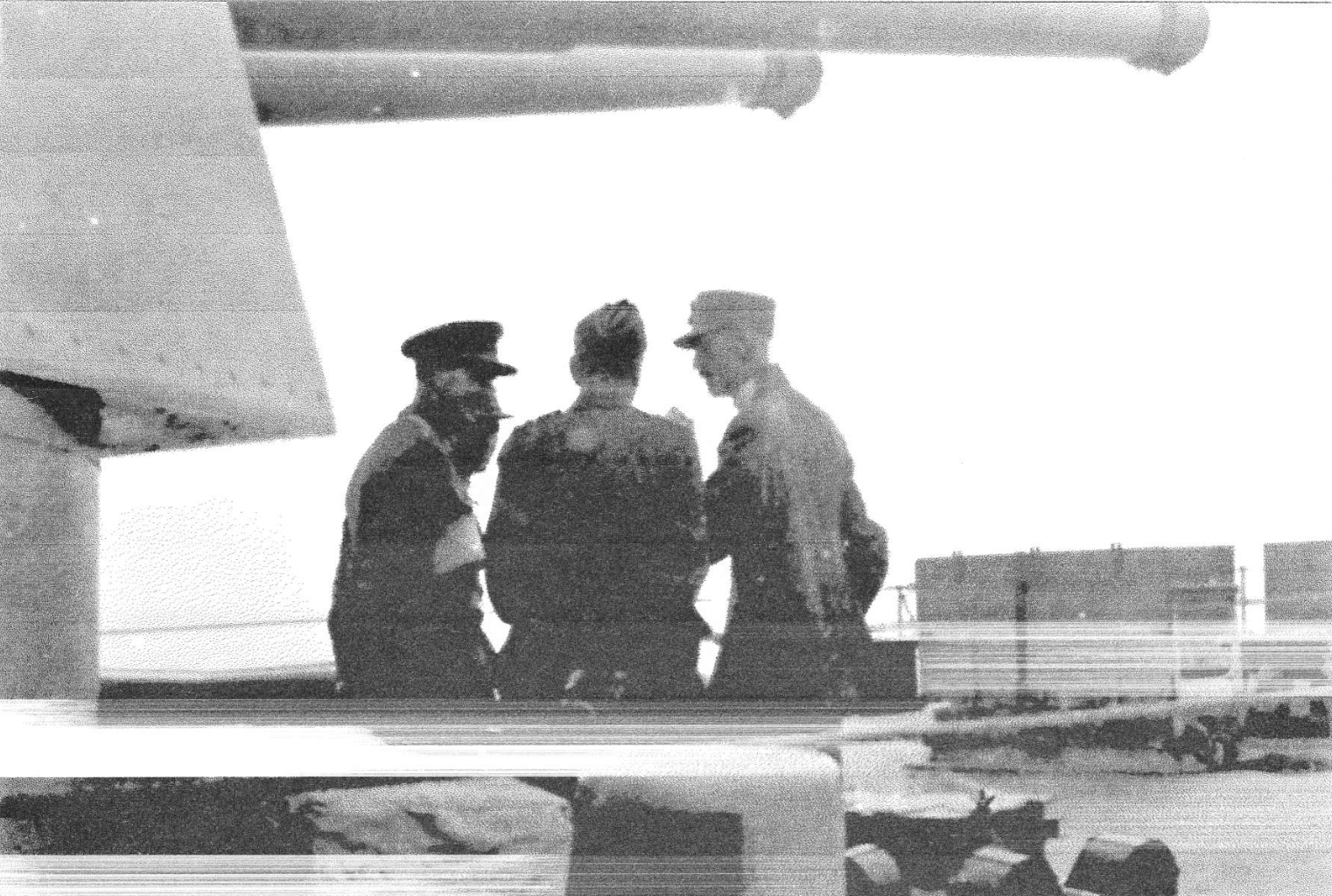
The photograph could easily have stayed in a drawer—like a family souvenir. Yet I’m sure he brought it out for the same reason he gave me the camera. Here’s a thing. Don’t just leave it. Go and do something with it. He also knew I had an interest in history because I’d been helping (read tech support) my Danish grandfather with his research into Danish history during the Reformation. So he asked if I’d arrange sending it to the Royal Court of Norway from Denmark. I did. We received a pleasant thank you letter from the Cabinet Secretary.
Directness is a habit, and with practice it turns into a lived principle. Go to the thing. Go to the person. Don’t work at one remove.
My Danish grandfather approached things the same way, which became even clearer after he retired from energy. That’s when he began his research into Danish and Reformation history, mostly the 1500s and 1600s. He spent thirty years travelling between Denmark, Sweden, Norway and Germany with nothing but a small digital camera and a laptop, sifting through church records, ship manifests, tax records, and religious satire.
He invited me to join many of his trips. One was to the Danish National Archives of Commerce. The materials were rarely complete and nothing was digital, so everything he looked at demanded patience. The written language of the 1500s and 1600s is nothing like now, so he spent years learning how to read the texts. Most of the work was tedious. He stuck with it and followed new threads as they came along. After years of that, it seemed as if he’d developed an instinct for finding useful clues.
On another trip we met a famous theologian in his late eighties who’d spent his life on Martin Luther’s role in the Reformation. My grandfather had asked him for help tracking down one of Luther’s closest allies. I didn’t really understand the conversation, but I remember the feeling of it—that it was allowed (maybe expected) that I’d take it seriously, even if I was only there to listen.
That instinct—knowing which box to open, knowing whom to ask—wasn’t a gift. It formed by staying with material that wouldn’t give him the answers, through the frustration and the years. From the outside it looks like magic or luck. From the inside it’s stamina.
I used to think my grandfathers did very different things—one designed machines, the other collected church records. Actually they were both just staying with what wasn’t written down.
When they passed away, the papers came to me—schematics, photographs, thirty years of research. I remember sorting through the boxes hoping to keep some of that instinct. Of course it was a fool’s errand. The drawings were all still there. What my grandpa knew about them wasn’t.
A few years ago I was sitting in the private office of someone who has spent his life at the top of shipping, with ship models on the shelves around us. I’d come to ask, more or less, how someone with my background could succeed in the industry. He said to focus on two things: economics and sales. Then he added a third. Keep a genuine interest in the technology. Read about it. You can outsource a lot in shipping, he said, but not the understanding, because it affects the whole business.
He was saying what my grandpa had said by the pond, only from the other side of the table. Economics and sales I could learn on the job. The third is why I write about industry. Mostly I start a post because there’s something I don’t understand yet.
The aerial photograph is still in the drawing room. It’s a good picture; you can see the whole farm on it. But I don’t think it was ever the point. The point was a month later, standing in the field with the camera, trying to work out where I was on it.